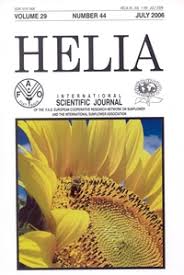
Research article | Open Access
HELIA 2026, Vol. 49(84) 48-61
Assessment of Combining Ability of Sunflower Lines Resistant to Sulfonylurea Herbicides in the Southern Steppe of Ukraine
pp. 48 - 61 | DOI: https://doi.org/10.29329/helia.2026.1446.4
Publish Date: June 12, 2026 | Single/Total View: 21/9 | Single/Total Download: 28/16

Abstract
To develop competitive sunflower hybrids, a sufficient number of parental components with agronomically valuable traits and a high level of combining ability is required. This study determined the general and specific combining ability of 40 inbred sunflower lines from the breeding programme of The Plant Breeding and Genetics Institute - National Center of Seed and Cultivar Investigation (Ukraine) that are resistant to sulfonylurea herbicides, with respect to seed yield under unstable moisture conditions in the Southern Steppe of Ukraine. The goal was to identify water-stress-adapted donors and to form highly productive hybrid combinations. Combining ability was evaluated in 2020–2023 for the trait “seed yield”. Significant variability in general and specific combining ability was observed depending on hydrothermal conditions and genotype. Statistical analysis of seed yield identified seven lines that consistently showed high combining ability and can be recommended for further breeding studies.
Keywords: Sunflower, Combining Ability, Inbred Lines, Seed Yield
APA 7th edition
Svitlakova, A., Varenyk, B., Karapira, S., Haidash, O., & Solodenko, A. (2026). Assessment of Combining Ability of Sunflower Lines Resistant to Sulfonylurea Herbicides in the Southern Steppe of Ukraine. HELIA, 49(84), 48-61. https://doi.org/10.29329/helia.2026.1446.4
Harvard
Svitlakova, A., Varenyk, B., Karapira, S., Haidash, O. and Solodenko, A. (2026). Assessment of Combining Ability of Sunflower Lines Resistant to Sulfonylurea Herbicides in the Southern Steppe of Ukraine. HELIA, 49(84), pp. 48-61.
Chicago 16th edition
Svitlakova, Alena, Borys Varenyk, Sergey Karapira, Oleksandr Haidash and Anzhella Solodenko (2026). "Assessment of Combining Ability of Sunflower Lines Resistant to Sulfonylurea Herbicides in the Southern Steppe of Ukraine". HELIA 49 (84):48-61. https://doi.org/10.29329/helia.2026.1446.4
- Dospekhov, B. A. (1985). Methodology of field experiments (with basics of statistical processing of results). Moscow: Agropromizdat. (In Russ). [Google Scholar]
- Fasahat, P., Rajabi, A., Rad, J. M., & Derera J. (2016). Principles and utilization of combining ability in plant breeding. Biometrics and Biostatistics International Journal, 4(1), 1-22. https://doi.org/10.15406/bbij.2016.04.00085. [Google Scholar] [Crossref]
- Griffing, B. (1956). Concept of general and specific combining ability in relation to diallel crossing systems. Australian Journal of Biological Sciences, 9(4), 463-493. https://doi.org/10.1071/BI9560463. [Google Scholar] [Crossref]
- Gundaev, A. I. (2018). Use of heterosis in sunflower breeding: Genetic and agronomic perspectives. Journal of Crop Improvement, 32(3), 245-267. https://doi.org/10.1080/15427528.2018.1458364. [Google Scholar] [Crossref]
- Ibitome, J. D. (2010). Heterosis and combining ability studies for yield components traits using diallel analysis among ten inbred lines of maize. World Journal of Agricultural Research, 3(5), 153-162. [Google Scholar]
- Ilchenko, A. S., Varenyk, B. F. and Karapira, S. I. (2024). Selection evaluation of new self-pollinated sunflower (Helianthus annuus L.) lines with resistance to sulfonylurea herbicides and downy mildew [Plasmopara halstedii (Farl.) Berl. et. de Tony]. Plant Varieties Studying and Protection, 20(1), 19-25. (In Ukr). https://doi.org/10.21498/2518- 1017.20.1.2024.300134. [Google Scholar] [Crossref]
- Kaya, Y., & Atakisi (2004). Combining ability analysis of some yield characters of sunflower (Helianthus annuus L.). Helia, 27(41), 75–84. https://doi.org/10.2298/HEL0441075Y. [Google Scholar] [Crossref]
- Khan, M. S., Swati, M. S., Khalil, I. H., & Iqbal, A. (2003). Heterosis studies for various characters in sunflower. Asian Journal Plant Science, 2(14), 1010-1014. [Google Scholar]
- Kobzar, O. H., & Osadchyi, V. I. (2018). Assessment of changes in hydrothermal conditions of the steppe zone of Ukraine under modern climate conditions. Ukrainian Geographical Journal, (3), 45–52. (In Ukr). [Google Scholar]
- Kucherenko, Y., Zviahintseva, A., Kobyzeva, L., Kolomatska, V., Makliak, K., Vasko, N., Lutsenko, T. (2022). Marker-assisted selection and use of molecular markers in sunflower breeding for resistance to diseases and parasites. The Journal of V.N.Karazin Kharkiv National University. Series «Biology», 38, 14-29. https://doi.org/10.26565/2075-5457-2022-38-2. [Google Scholar] [Crossref]
- Litun, P. P., Kyrychenko, V. V., Petrenkova, V. P., & Kolomatska, V. P. (2009). System analysis in breeding of field crops: Training manual. Kharkiv: NAAS of Ukraine. (In Ukr). [Google Scholar]
- Makаrchuk, O. S. (2021). Assessment of combining ability of maize inbred lines using various testers. Breeding and Seed Production, 120, 45-51. [Google Scholar]
- Malik, I. (2004). General and specific combining ability studies in maize diallel crosses. International Journal of Agriculture & Biology, 6(5), 856-859. [Google Scholar]
- Qadir, A., Skakun, S., Becker-Reshef, I., Kussul, N., & Shelestov, A. (2024). Estimation of sunflower planted areas in Ukraine during full-scale Russian invasion: Insights from Sentinel-1 SAR data. Science of Remote Sensing, 10, 100-139. [Google Scholar]
- Shevchenko, A., Petrenko, O., & Gelas, V. (2024). Strategic development of sunflower growing in Ukraine: challenges and prospects. Economic Bulletin of the Black Sea Littoral, 5, 133-145. (In Ukr). [Google Scholar]
- Solodenko, A. Ye., & Fayt, V. I. (2018). Usage of DNA markers for screening and identification of sunflower genotypes of hybrid origin on AHAS1 gene. OIL CROPS. Scientific and technical bulletin of the All-Russian Research Institute of Oil Crops, 1(173), 3-9. (In Russ). https://doi.org/10.25230/2412-608X-2018-1-173-3-9. [Google Scholar] [Crossref]
- Solodenko, A. Ye., Ilchenkо, A. S., & Varenyk, B. F. (2018). Effectiveness of microsatellite marker pAHAS 16-17 for introgression of herbicide resistance gene AHAS1 into sunflower breeding material. The Bulletin of Kharkiv National Agrarian University. Series Biology, 2(44), 94-99. (In Ukr). [Google Scholar]
- Sprague, G. F., & Tatum, L. A. (1942). General vs. specific combining ability in single crosses of corn. Journal of the American Society of Agronomy, 34(10), 923-932. https://doi.org/10.2134/agronj1942.00021962003400100008x. [Google Scholar] [Crossref]
- Sydiakina, O. V., & І. О. Podriezov. (2024). Sunflower: current state, problems and prospects for production. Taurida Scientific Herald, 136(2), 124-133. [Google Scholar]
- Sych, Z. V., Zhemoida, V. L., & Sydorka, I. V. (2004). Vyvchennia kombinatsiinoi zdatnosti u selektsii heterozysnykh hibrydiv metodom nepovnykh top krosiv [Study of combining ability in breeding of heterosis hybrids by the method of incomplete top crosses]. Kyiv: NAU. (In Ukr). [Google Scholar]
- Volf, V. G., Dumacheva, L. P., & Kiryushin, V. I. (2017). Heterosis effect in sunflower: Genetic determinants and environmental influence. Russian Journal of Genetics: Applied Research, 8(3), 301-315. (In Russ). https://doi.org/10.1134/S2079059720030156. [Google Scholar] [Crossref]
- Zhang, H., Li, R., Wang, X., Liu, J., & Sun, X. (2021). Hybrid vigor and combining ability analysis in sunflower under different environmental conditions. Plant Breeding, 140(2), 223-234. https://doi.org/10.1111/pbr.12891. [Google Scholar] [Crossref]